
The year began on a strong footing for financial markets, but that changed quickly as February came to a close with the sudden onset of military action involving Iran. As one might expect, the news unsettled investors. Oil prices surged, stock prices pulled back, and uncertainty returned to the headlines. That said, the economy entered this period in solid shape, and at this point, we believe any oil shock is more likely to be temporary than lasting. Markets have a way of looking past even serious events once there is some visibility on how they may unfold. When that happens, investor confidence tends to return faster than most expect. In the meantime, patience remains an important ally.
Not Our First Rodeo
Periods like this can feel uncertain, but they are not unfamiliar. Pring Turner has been managing investment portfolios since 1977. This year marks our 49th year navigating markets through all kinds of environments — wars, inflation, recessions, financial crises, and even a global pandemic. None of those periods felt comfortable in the moment. All of them passed. And, in time, markets adjusted, opportunities emerged, and disciplined investors were rewarded.
The reality is that no one can predict the future with certainty. In fact, one principle that has guided our work for decades is simple: we don’t know. We don’t know specifically what the future will bring. Nobody does. Yet, we must make decisions today with an always uncertain future and generate a successful outcome for you. That is why we have built an approach centered first and foremost on risk management, incorporating multiple layers of analysis including fundamental factors, technical trends, monetary conditions, investor sentiment, and paying close attention to the business cycle. Together, these tools are designed to help reduce risk and improve long-term outcomes, even in uncertain environments. The steady growth of our firm over the last 49 years has been a testament to a conservative investment process originated by our founders and carried out by your investment team today.
Oil’s Well that Ends Well!
Right now, the market’s focus is squarely on oil. As the conflict began, oil prices briefly spiked toward $120 per barrel on fears of supply disruption through the Strait of Hormuz. Since then, prices have eased back into a volatile range roughly between $80–$105. Stocks have been reacting accordingly — rallying when oil pulls back and struggling when it moves higher. For the moment, that relationship is driving day-to-day stock market behavior.
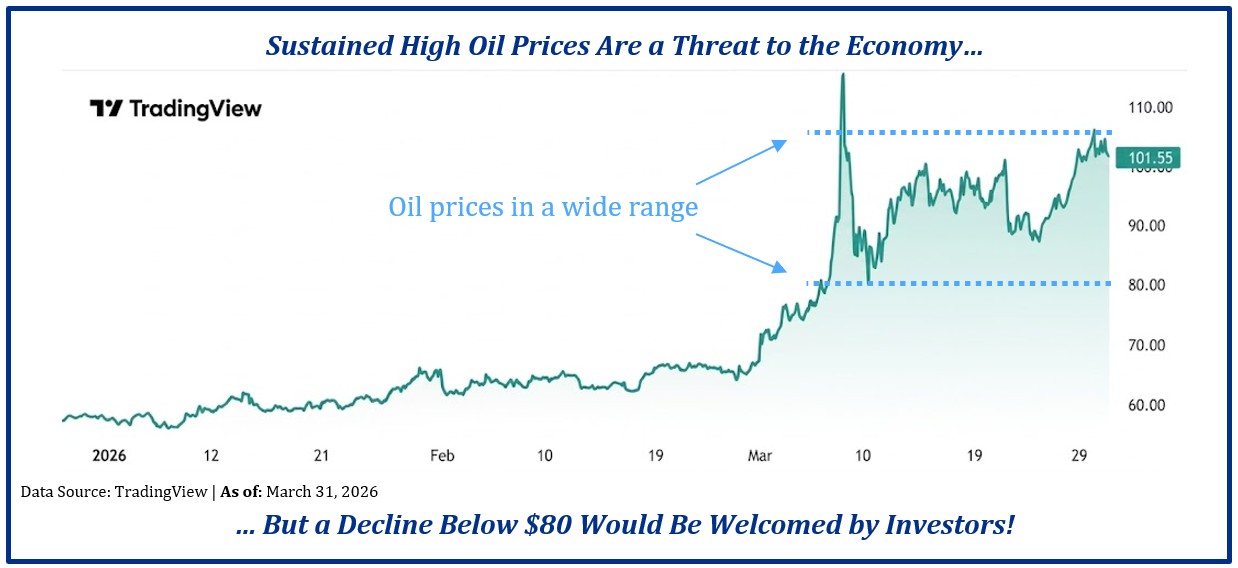
If oil were to remain elevated for an extended period, it could slow global growth enough to raise concerns about a global recession. In mid-March we forwarded Martin’s research article on that possibility: “Oil: Will the Price Spike Tip the Economy into Recession”. The conclusion was there is no sign of recession yet—with leading indicators for the economy pointing higher. However, we are watching economic indicators and oil prices carefully for any change in the outlook.
One upshot of higher oil prices is the effect of putting upward pressure on inflation and interest rates. We saw some of that in March, as bond yields moved higher and bond prices declined despite their usual role as a safe haven. In response, we continue to favor shorter-term bond strategies and expect to eventually take advantage of higher yields to increase the income potential of your portfolio.
Energy stocks have been a significant area of strength, benefiting directly from higher oil prices. We continue to view this area favorably and expect solid earnings even if tensions begin to ease. Notably, energy producers have been selling oil forward in the futures market, thereby locking in steady profits in the quarters ahead. Their actions signal this spike in oil prices may be temporary. Indeed, futures pricing suggests over the next six-to-twelve months prices could decline by $25 to $35 per barrel. While our long-term outlook remains positive, we wouldn’t be surprised to see a short-term pullback in energy stocks if oil prices normalize. On the other hand, broader financial markets would welcome that outcome.
What’s Next?
Periods like this—when uncertainty is high and headlines are intense — often create the conditions for meaningful market rebounds. Indeed, one may have started just as the quarter came to a close. It would not be unusual to see a strong rally develop over the coming weeks. What matters most, however, is the character of that rally. A broad, sustained advance would point to a healthier, longer-lasting market cycle. A weaker or more uneven rebound would tell us to stay cautious and act to become even more defensive. We are prepared for either outcome.
Behind the scenes, your portfolio is continuously stress-tested across a range of scenarios. Our job is not to guess what will happen next, it is to be ready for what could happen, and to adjust when the evidence becomes clear. At the same time, we remain optimistic about the balance of 2026, particularly as this conflict moves toward resolution.
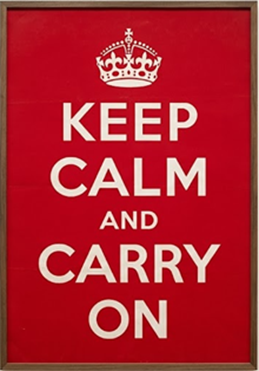
In times like these, we are reminded of the World War II message from Great Britain: “Keep Calm and Carry On.” It may sound simple, but it captures something important. The most successful investors are often those who stay steady when it would be easiest not to.
We are monitoring developments closely and stand ready to act decisively to both protect and grow your portfolio. As always, we appreciate your continued trust and welcome any questions you may have.
For a look back at our outlook coming into this year, see our previous update: Happy Old Year: Here’s to 2026.
