
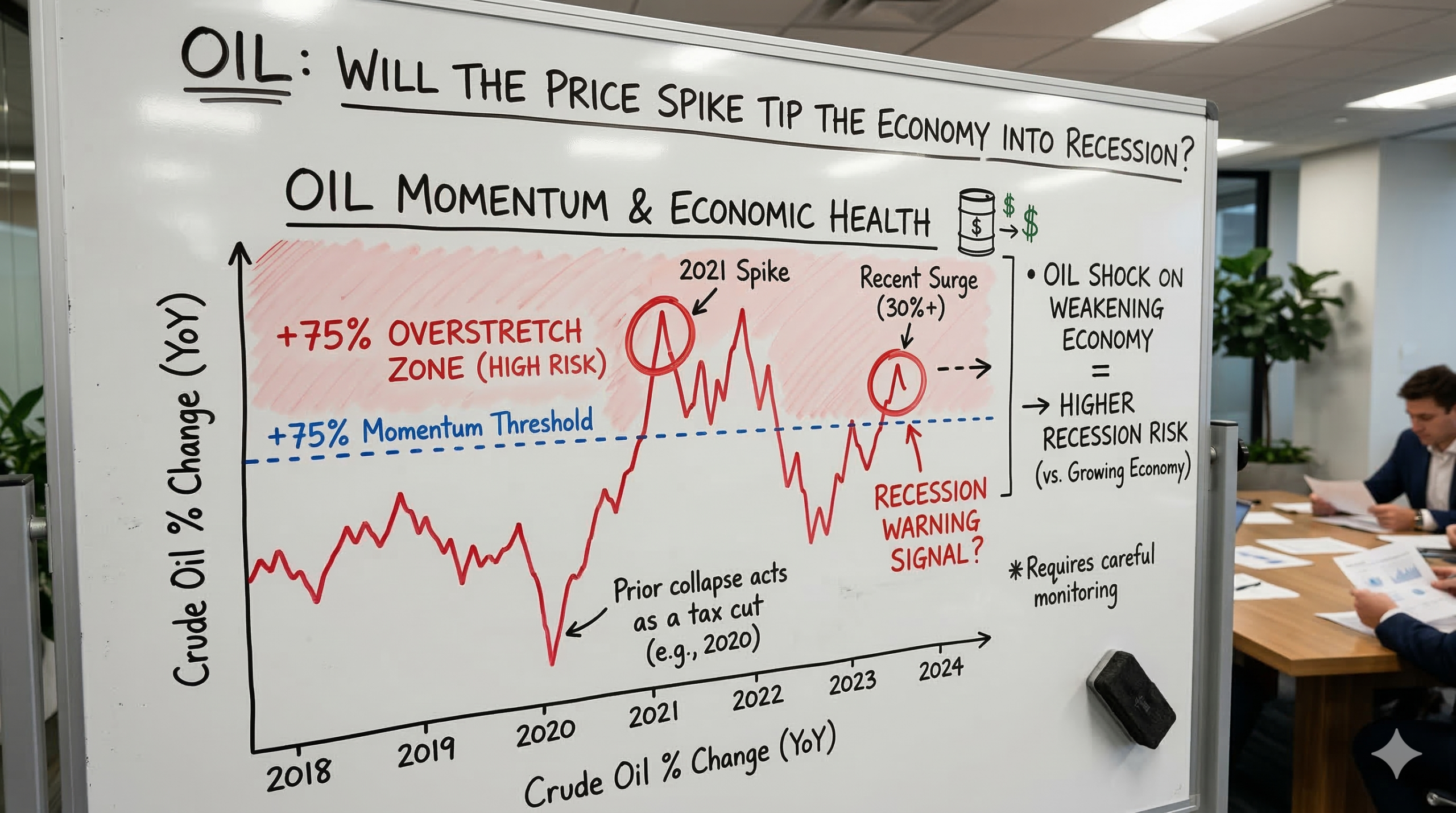
The recent 30% surge in crude oil prices has led many observers—drawing on memories of past energy crises—to immediately warn of recession. That may ultimately prove correct, but we’re cautious about narrative‑driven, back‑of‑the‑envelope predictions. We prefer to ground our outlook on evidence, and that starts with understanding where the economy was headed before the oil shock hit.
High energy prices have historically had a much stronger impact on an economy that is already weakening than on one that is emerging from recession. Chart 1 shows our Pring Turner Leading Economic Index (PTLEI), a weighted composite of labor, consumer, housing, and financial indicators. It also drives our Recession Caller, shown in the middle panel. The Caller signals recession when it drops decisively below the red threshold under the equilibrium point—a method that has performed well since the 1950s. The major exception was 2020, when the artificially induced shutdown caused the indicator to lag sharply, as was the case with most models at the time. One indicator that did not lag was the OECD’s U.S. Leading Indicator, which had already peaked a couple of years earlier. It has led every recession since the 1950’s and is shown in the bottom panel.
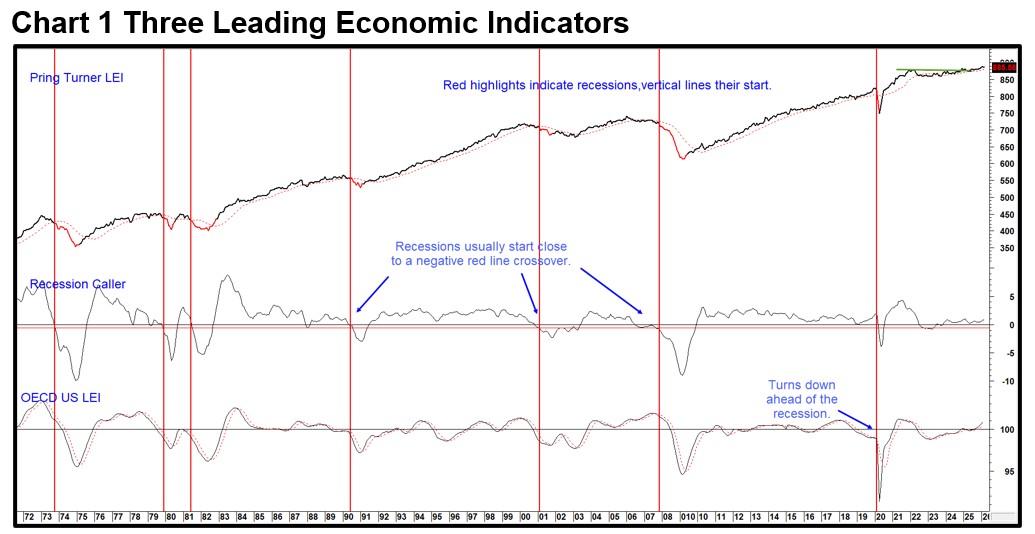
Both indicators forecasted further growth prior to the oil shock.
By the end of February this year, the OECD LEI was clearly trending higher, suggesting the economy had enough underlying strength to absorb an oil shock of some size. Our own PT LEI is sending a similar message: its latest reading sits comfortably above the recession threshold, and the indicator recently broke out of its 2021–2024 trading range, another sign of improving momentum.
Rate of Change is More Important than Level
People often focus on the level of prices or interest rates, but in economics it’s usually the speed of change that causes the real trouble. If inflation edges up by a tenth of a percent a year, no one reacts—you can adjust wages, budgets, and expectations without stress. But if prices jump 2% in a single month, people rush to buy before things get worse, velocity rises, and the surge feeds on itself. Rapid shifts create uncertainty, and uncertainty is toxic for investment. It’s the difference between gradually easing up to highway speed and slamming the accelerator or hitting a wall.
The Effect of Fast-Moving Oil Prices
Chart 2 builds on this idea by comparing Industrial Production, our stand‑in for the U.S. economy, with the 12‑month rate of change in crude oil prices. Recessions are highlighted in red, and the vertical lines mark periods when the oil ROC pushes above its overstretched +75% level. There are two probable outcomes. The green lines highlight episodes when the ROC surges from deeply negative territory below – 50%. These usually occur after a recession or slowdown. In these instances, the prior collapse in oil prices acts like a tax cut, which helps jump‑start economic activity. The 2010 and 2021 signals followed recessions, while the 1987 case came after a growth slowdown tied to weakness in the agricultural and industrial belts—enough to drag on the economy but not sufficient to trigger a recession. In all three instances, the overstretched reading was essentially a rebound, signaling an economy getting back on its feet.
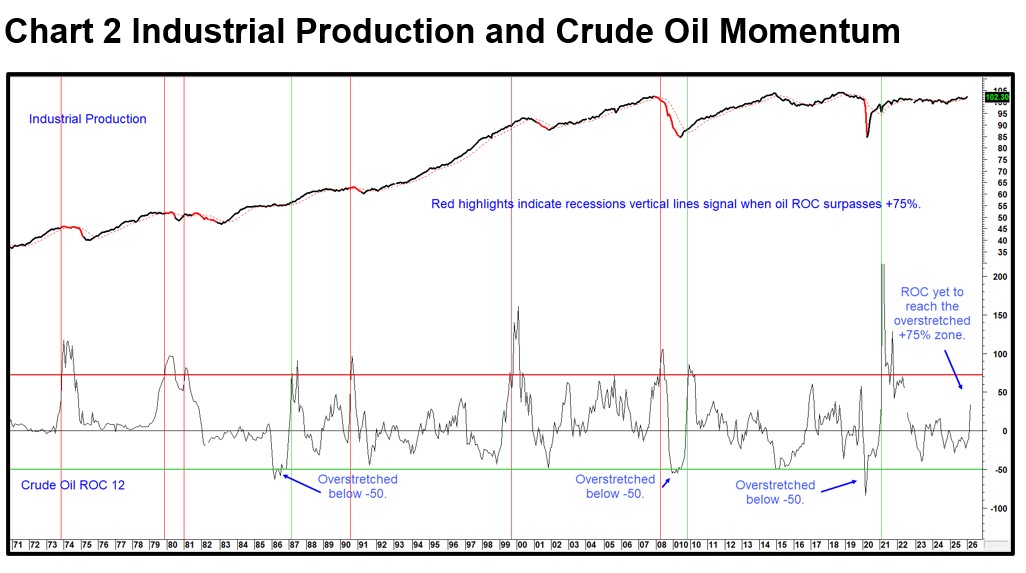
If YoY crude oil momentum exceeds +75% late in the cycle, expect a recession.
The red vertical lines tell a different story. They appear later in the cycle, when capacity constraints are tightening and oil prices have become extremely sensitive, even to small shifts in demand. In that environment, a push above the +75% zone often develops close to the onset of recession.
Implications for the Stock Market
The implications of a +75% oil ROC for equities are less straightforward, but the signals have generally leaned bearish. Chart 3 compares the oil ROC with the inflation‑adjusted S&P Composite. All of the late‑cycle signals identified in Chart 2 are associated with bear markets. We say “associated” because the timing varies: some signals appear before the bear gets underway, others during the decline, and in the 1990 case, right at the bear market low. In both 1987 and 2021, the oil ROC warning was followed by rising industrial production, yet each instance still gave way to a subsequent equity downturn—the 1987 crash and the 2021-2022 bear market. Even the 2010 signal was followed by elevated levels of volatility. These three examples were delayed reactions, not due to a business‑cycle contraction, rather a reflection of heightened investor nervousness.
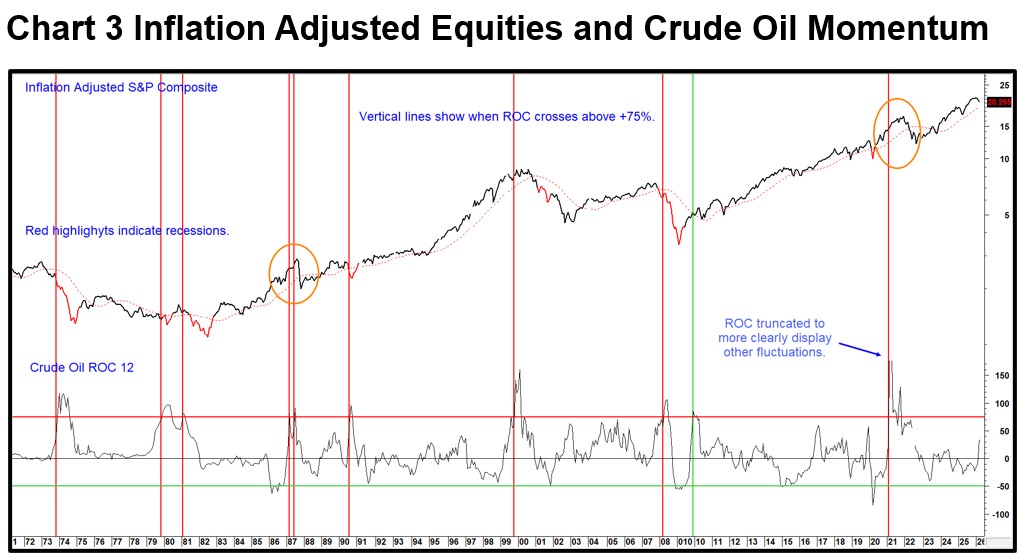
An oil momentum sell signal has not yet been triggered but if it is, watch out!
Conclusion
Two conclusions follow. First, the Iran conflict has not yet produced an extreme overstretched oil momentum reading. A growing economy, much like a massive oil tanker, requires a substantial negative force to reverse direction. Without an oil‑based sell signal, the constructive outlook suggested from the leading indicators presented in Chart 1 remains the more likely path for both the economy and equity market. Second, if such a signal does emerge, history suggests a recession would probably not be far behind. Equities do not like weak economies. Hence, all eyes remain laser-focused on securing and reopening the Strait of Hormuz.
Martin J. Pring