

Last April, we wrote an article entitled “Why the Fed May Be Forced to Raise rates, Not Lower Them”. At first glance, our conclusion might appear off the mark. After all, the central bank has since lowered rates three times, to the tune of 100 basis points, justifying the move on expectations of a moderating CPI (unless otherwise stated, CPI refers to the year over year change in the Consumer Price Index). For its part though, the bond market is taking our side of the argument, as the yield on the 20-year maturity has risen just shy of 100 basis points since the week prior to the initial September cut.
Our rationale is unchanged as a firming up in CPI inflation is still a strong possibility. Indeed, we concluded by saying “If another wave of higher inflation does materialize and the Fed temporizes, as it did in 2021 that would push yields and inflation higher, finally bringing about the long-awaited recession and causing it to be far more painful than would otherwise be the case.”
So far, that wave of higher inflation has not materialized, but year over year CPI has barely budged on the downside either. By the same token, our business cycle indicators suggest that commodity inflation, which almost always leads CPI inflation, could be about to flare up. Furthermore, the Fed is no longer acting as a constraining force, as was the case last spring. Now, with a 100-basis point rate decline in the bag, it’s more of a stimulative one.
The Current Business Cycle Phase is Bullish for Commodities
At Pring Turner we believe that the business cycle is nothing more or less than a set series of chronological sequences. In simplistic terms, the cycle begins with falling interest rates as a recession unfolds. These lower rates stimulate the purchase of new homes, which need to be furnished. The increased demand for consumer durables eventually eats up spare capacity, which leads to the initiation of capital spending projects. As delivery times shorten, tightness in the system drives up commodity prices and interest rates. Eventually, higher rates feed back into the economy, and are followed by a recession, or in some cases a growth slowdown. A new cycle is then ready to begin.
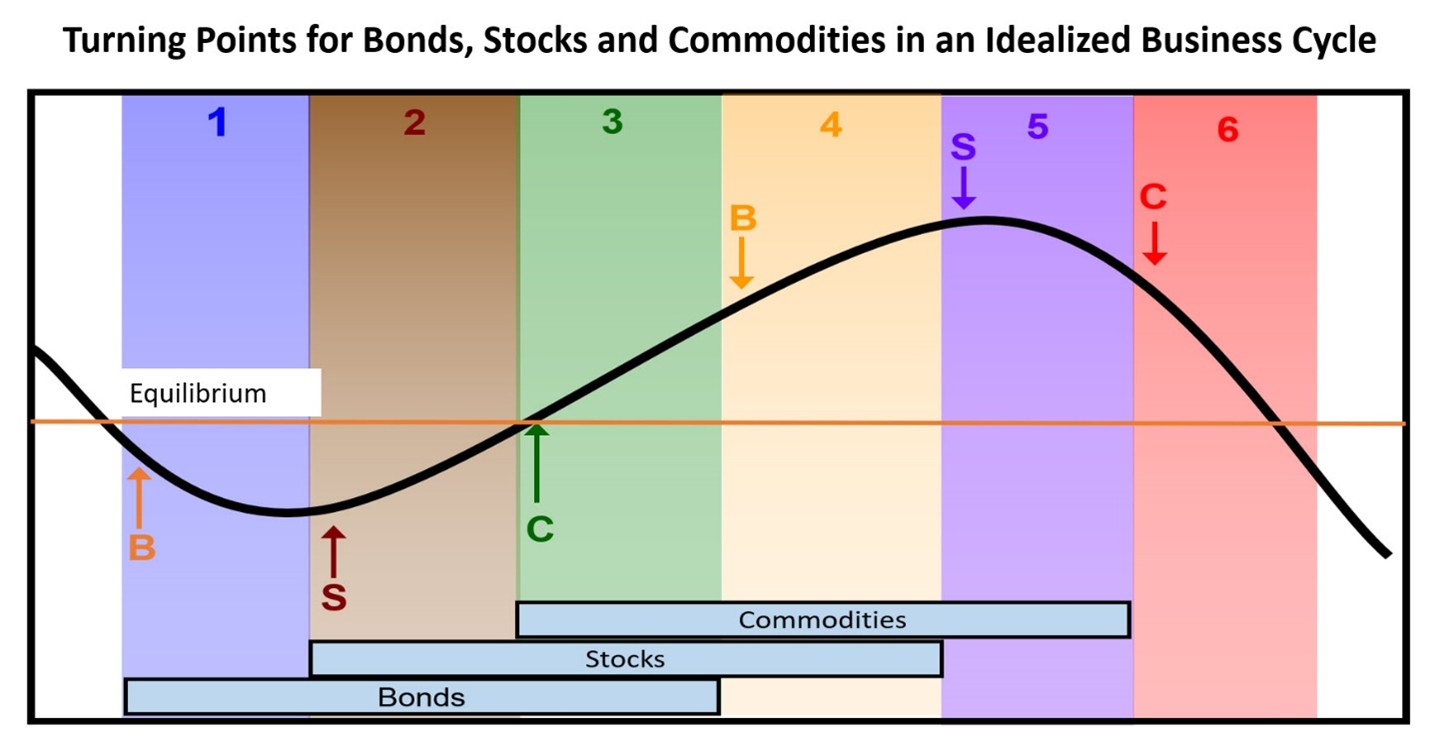
Fortunately for market watchers, this chronological sequence includes the primary trend turning points for bonds, stocks and commodities, as shown in Figure 1. Since there are three markets and each has two turning points the cycle may be conveniently broken down into six stages or “seasons”. The diagram shows each phase is suitable for different asset mixes.
Stage 2, for example, favors stocks and bonds.
Stage 4 sees commodities and commodity sensitive sectors outperform a bearish bond market.
The diagram highlights these relationships and demonstrates how different phases of the cycle align with distinct investment asset mixes. A deeper explanation of this chronological business cycle concept can be found here. The current stage of the cycle is determined by proprietary models and barometers, which are updated monthly in the Intermarket Review.
The business cycle is at Stage 3 but came very close to Stage 4 in January. When signaled, this is the most inflationary phase for commodities.
Normally, our models reflect a clearsighted picture vis a vis the prevailing phase of the cycle. In the last year though, key components for the bond and inflation varieties have been subject to unusual equivocation, as our models have switched between Stages 3 and 4 a couple of times.
Currently all three are in a bullish mode, which places the cycle in Stage 3. That said, it was only by a statistical fluke that the Bond model avoided bearish territory in January, thereby signaling Stage 4. Stronger commodity prices in February suggest the Bond model will have trouble maintaining that positive status.
That’s important because Stage 4 has averaged just under 7 months since the mid-1950’s. It’s a far more inflationary stage than its predecessor, as the average annualized monthly return for commodities comes in at +13%. This phase of the cycle usually favors earnings-driven stock market sectors.
The green highlights in Chart 1 show us when the Inflation Barometer is at 50% or higher. It’s currently at 75%. During these times, the CRB Spot Raw Industrial Index is usually experiencing a strong primary bull market.
Chart 1 Pring Turner Inflation Barometer vs. CRB Spot Raw Industrials
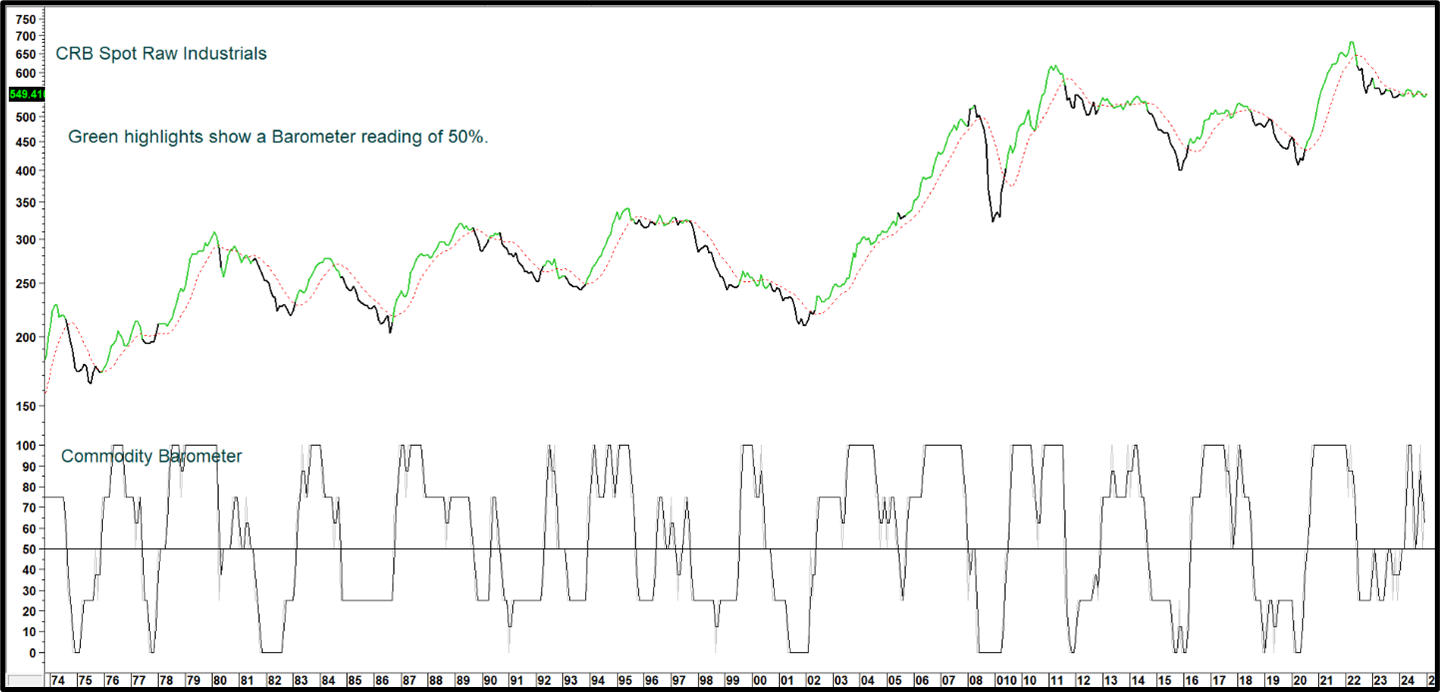
The Barometer is currently bullish for industrial commodity prices and inflation.
Relating Gold, Commodities, and the PPI Finished Goods to the CPI
The chronological sequence approach to the business cycle can be taken a step further by applying it to turning points in gold, industrial commodity prices the Producer Price Index (PPI) for finished goods, and finally the Consumer Price Index itself.
Gold is useful because it is a leading indicator for industrial commodities. This relationship is demonstrated by the vertical lines in Chart 2, which intersect with the lows for gold momentum. The blue horizontal arrows indicate that commodity momentum consistently lags that for gold at cyclical lows.
Gold momentum started the cycle well over a year ago. The industrial commodity oscillator is at a subdued level, but nevertheless in an established uptrend. This relationship does not tell us anything concerning the magnitude of the implied commodity rally, merely that it is consistent with Stage 3, 4 or 5 in the business cycle.
Chart 2 Gold vs. Industrial Commodity Momentum
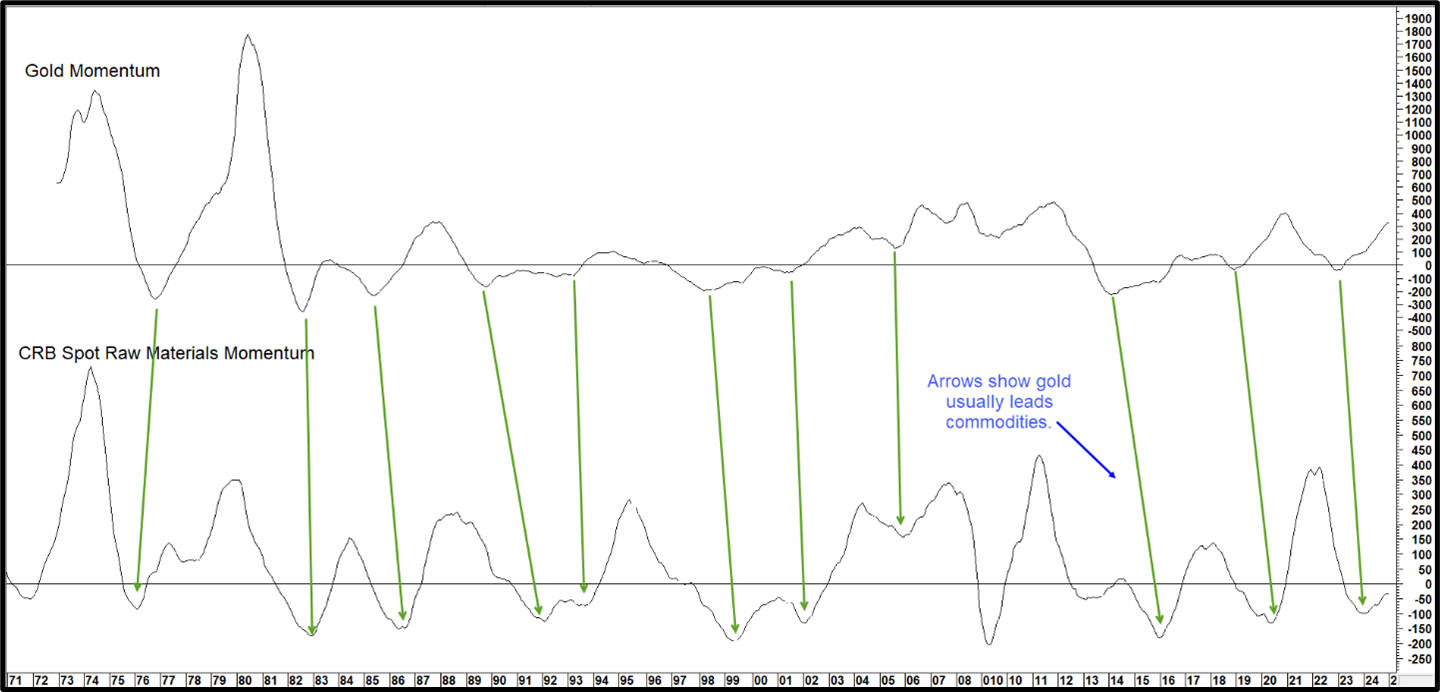
Gold momentum is rising and therefore leading commodities higher.
However, gold’s recent long-term price breakout in inflation-adjusted terms, as shown in Chart 3, suggests there is plenty of unrealized upside potential. The long-term smoothed momentum in the lower window has just turned bullish. If past is prolog, this signal should be followed by higher commodity prices.
Chart 3 The CPI Adjusted Gold Price (Quarterly)
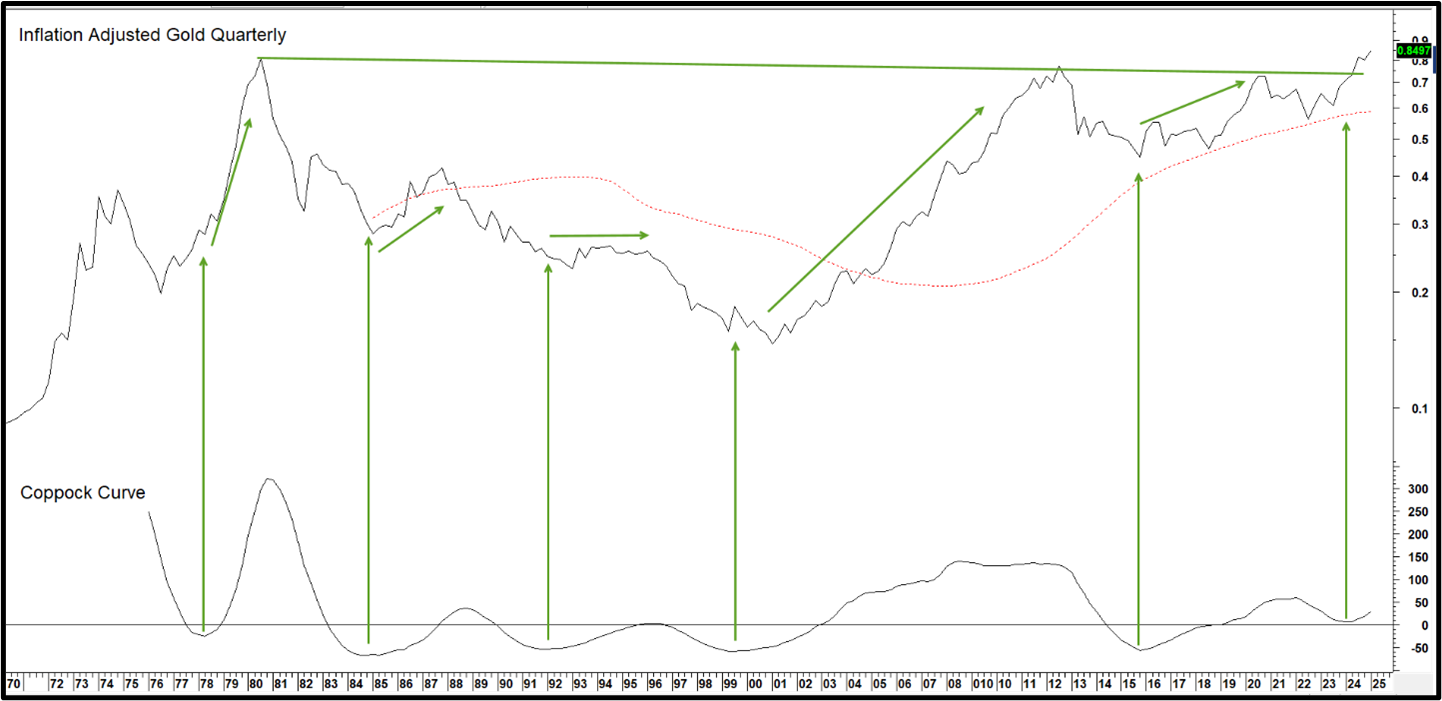
Gold has recently broken out from a huge consolidation pattern with long-term inflationary consequences.
Since gold leads commodity prices, the discounting process begins when long-term momentum for the ratio between them bottoms and ends when gold starts to underperform commodities as momentum reverses to the downside. The lower window in Chart 4 shows that momentum peaks are typically followed by firmer commodity prices, which in this case is the more broadly based CRB Composite.
While we cannot yet say that momentum has peaked for the current cycle, it has certainly begun to flatten. In almost all situations though, flattening is a reliable sign of an impending reversal, so be warned.
Chart 4 Commodities vs Gold/Commodity Momentum
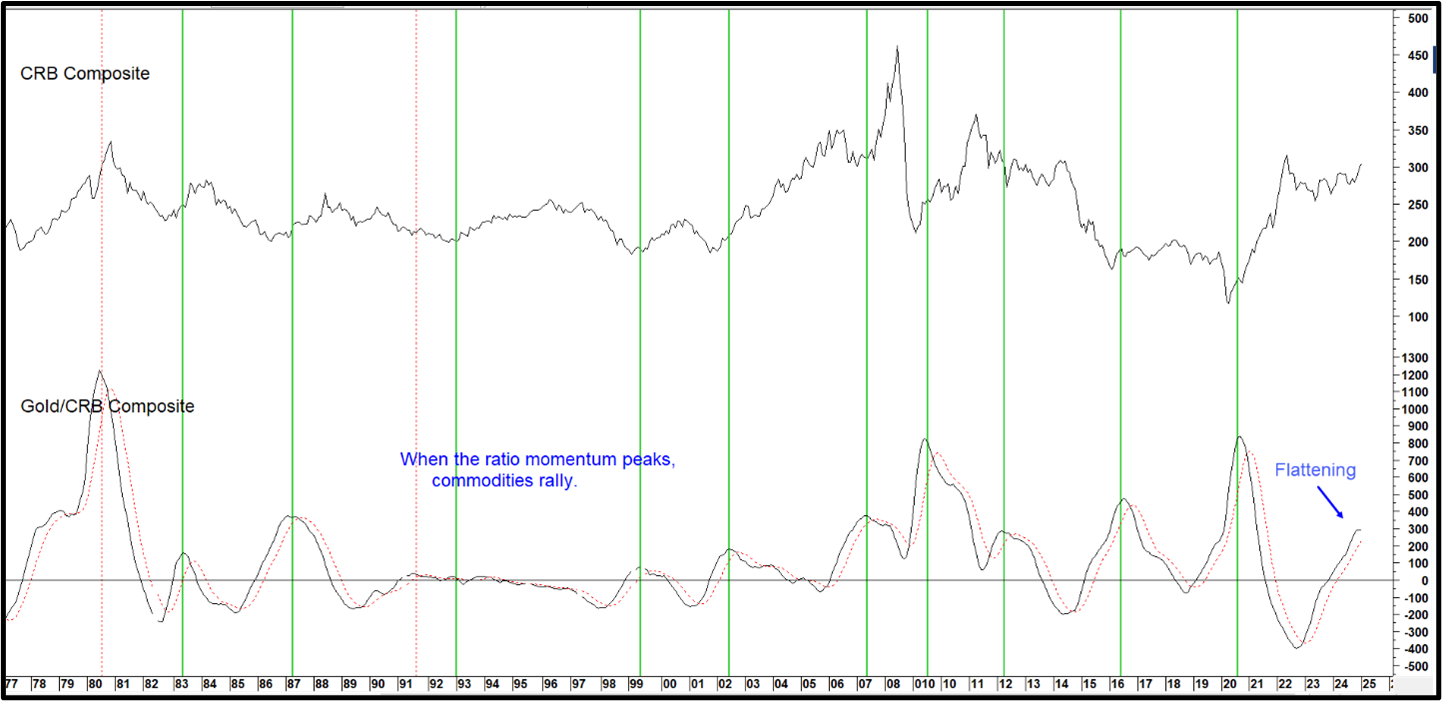
When gold/commodity momentum peaks, expect commodities to rally.
If Commodity prices rally, the next step is to compare their performance with year-over-year CPI changes. In that respect, the lower window of Chart 5 displays the momentum of the ratio between them. When the oscillator bottoms, it indicates that rising commodity prices are starting to pressure consumer price inflation. The vertical lines identify the cyclic lows in this relationship.
Observing the periods following these lows, it becomes evident that a reversal is invariably followed by a firming up in the CPI, or, at the very least an extended period of a sideways move. The signals tell us nothing about the magnitude and duration of the impending inflationary wave, merely its direction.
To discover when a deflationary trend evolves into a disinflationary one, we need to await a downside reversal in this relationship. Currently, the oscillator is in a positive mode, suggesting that an up wave in consumer price inflation could develop at any time.
Chart 5 Year over Year CPI vs Commodity/CPI Momentum
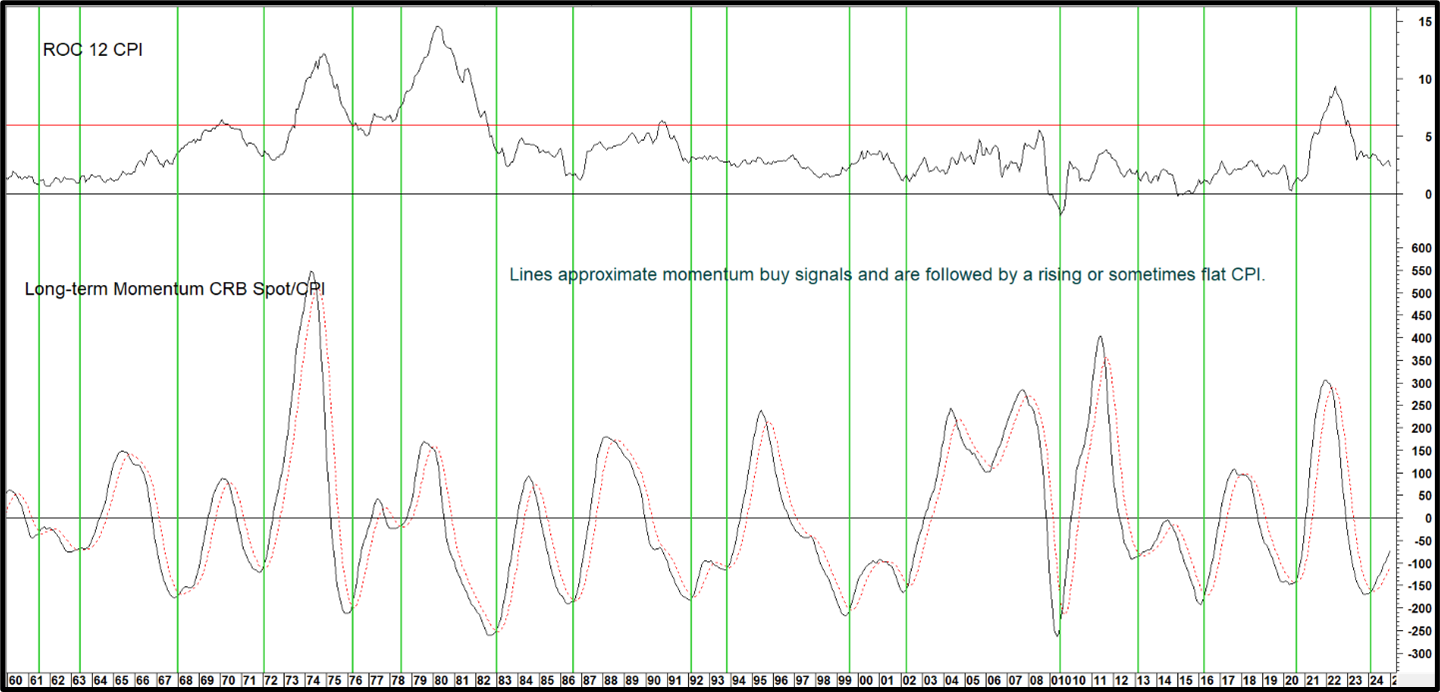
When momentum for the Commodity/CPI ratio bottoms, expect the CPI to move sideways or more likely experience a cyclical up wave.
Chart 6 reveals the chronological sequence that follows. In that respect, the bottom panel features a similar relationship with the CPI; however, instead of comparing it to industrial commodity prices, the PPI for Finished Goods has been substituted. The vertical lines flag these momentum lows.
The small blue arrows identify the sequence whereby the commodity-to- CPI ratio leads the PPI-to-CPI ratio. Most important of all, is the fact that the PPI/CPI oscillator has just triggered a CPI “buy” signal. That signals an important upward shift in consumer price inflation.
Chart 6 PPI Finished Goods Momentum vs the Year Over Year CPI
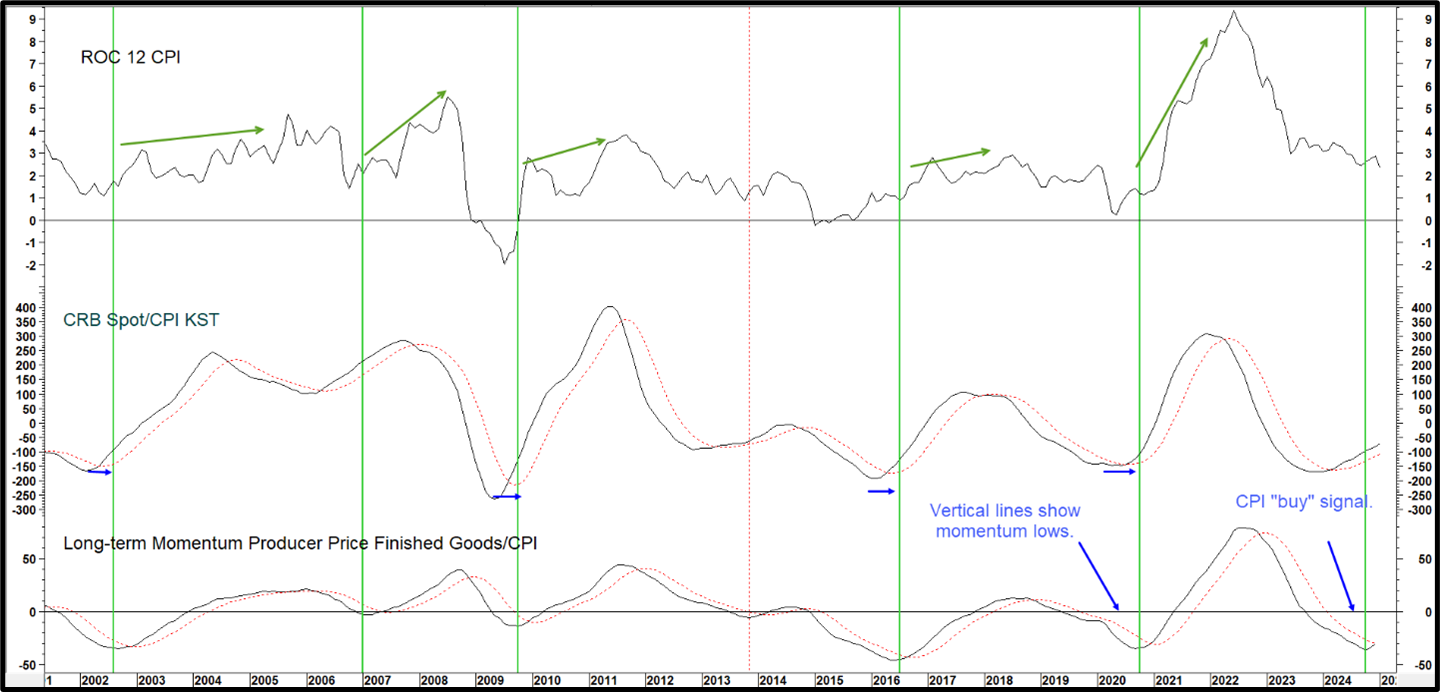
Shows the lead characteristics between industrial commodities and the PPI for Finished Goods and the CPI.
Conclusion
Consumer price inflation moves in waves, which do not develop in isolation but are part of a chronological sequence. This sequence begins with inflationary expectations in the gold market, eventually leading to higher industrial commodity prices. These pressures subsequently filter through to the PPI for Finished Goods and, finally, the CPI itself.
The current position of our business cycle and sequential indicators suggests the post-2022 CPI down wave is in its terminal phase, and a new up wave likely to begin. While it is impossible to predict the magnitude or duration of this next wave, a weak expansion in M2 suggests that the next wave is likely to fall well short of the of the 2020-2022 experience.
On the other hand, the upcoming wave will probably be sufficiently powerful to affect Fed policy and heighten volatility in the equity market. Successfully navigating these changes will require investors to carefully monitor the chronological sequence embedded in the business cycle to avoid potential pitfalls. Active asset allocation investment managers may even become popular once again!
Discover How We Can Help You Navigate the Market Cycle!

Martin Pring
Investment Strategist
Martin, founder of Pring Research in 1978, is a financial market expert, author of 20+ investing books, and co-founder of Pring Turner Investment Management. Renowned for ‘Technical Analysis Explained’, his work spans asset allocation, market psychology, and business cycle investing. Martin, a key figure in developing the Dow Jones Pring U.S. Business Cycle Index, has received multiple lifetime achievement awards for his impactful research. An adjunct professor at Golden Gate University, he taught the first virtual graduate-level course on technical analysis, solidifying his global influence as a sought-after speaker in over 30 countries.