

This commentary was prepared for clients on July 2, 2026.
The second quarter ended very differently than it began. When we last wrote in April, markets were wrestling with a sudden spike in oil prices following the military conflict involving Iran. At the time, we suggested that a rally would not be unusual and that what mattered most was not whether a rebound occurred, but the character of that rebound. Would it be broad and sustained, signaling a healthier market environment? Or would it be narrow and uneven, suggesting a more defensive posture was warranted?
The verdict is now in, and it is encouraging. As we suspected, the oil spike proved more temporary than lasting. Energy markets stabilized, the feared supply disruption never fully materialized, and oil prices moved back toward more normal levels. Investors who remained patient through the uncertainty were rewarded as markets recovered, and many major indexes moved toward new highs. However, the real story of the first half of 2026 is not oil. It is what the rally revealed about the underlying health of the market.
Amid Volatility, Market Leadership Broadens
In January, we suggested that 2026 might be a year in which market leadership broadened beyond the mega-cap growth stocks that dominated returns in recent years. At the time, a handful of very large companies continued to account for a disproportionate share of market performance, while many other sectors and industries struggled to keep pace. We believed that could change, and six months later, the evidence suggests it is beginning to happen. For a look back at that outlook, see our January letter, “Happy Old Year: Here’s to 2026.”
Rather than being driven by a small group of familiar leaders, the market’s advance has become increasingly broad-based. Areas that lagged in 2025—including energy, railroads, and real estate investment trusts (REITs) have begun to participate. Leadership has expanded across a wider range of industries and investment styles. This type of rotation is not unusual. In fact, it is often a healthy sign.
Markets rarely move in a straight line. Leadership changes hands as economic conditions evolve, valuations adjust, and investors begin to recognize opportunities in areas that were previously overlooked. While these shifts can create short-term volatility, they frequently help extend the life of a bull market by creating new sources of strength. In many ways, broadening participation is exactly what we hoped to see.
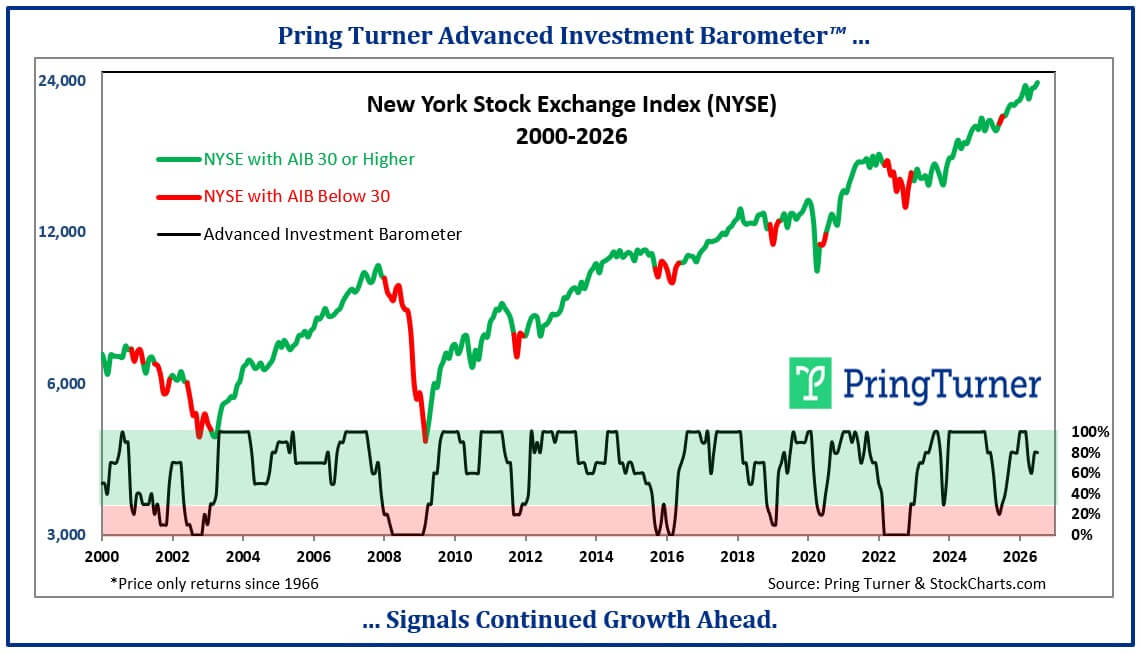
Advanced Investment Barometer Signals Continued Growth
In January, we wrote that the market could broaden beyond last year’s mega-cap winners. That observation was based on a combination of business-cycle analysis, valuation considerations, and market leadership trends. While six months is too short a period to declare victory, the broadening we anticipated appears to be underway.
This is important because market breadth often provides valuable clues about the durability of a market advance. When gains become concentrated in fewer and fewer stocks, the market can become increasingly vulnerable. When participation expands, the foundation beneath the advance generally becomes stronger.
One important bit of evidence to back up our still positive market outlook is the most recent reading in our AIB. This primary trend stock market model temporarily dipped into caution mode after the onset of Iran hostilities but has since advanced back into growth mode. While shorter-term market corrections remain possible, the latest reading is a reassuring sign that the bull market remains in place as we enter the second half of the year.
What’s Ahead for Portfolios in Late 2026?
Our investment philosophy remains unchanged. Rather than chasing yesterday’s winners, we continue to focus on high-quality businesses, attractive valuations, and growing income streams. As opportunities develop, we seek to trim positions that have become fully valued and redeploy capital into areas where the risk/reward relationship appears more favorable.
This discipline is especially important during periods of market rotation. Some of the portfolio activity this year reflects our belief that leadership would broaden beyond a narrow group of stocks. Our objective is not to predict every market move. It is to continuously improve portfolio quality while managing risk and positioning for future opportunities.
As always, we combine our Quality, Value, and Income (QVI) approach with ongoing business-cycle analysis and our proprietary market indicators. Together, these tools help us stay focused amidst the noise and maintain perspective when uncertainty is highest.
Staying Alert: Risks We’re Monitoring
While we are encouraged by the market’s resilience and the broadening of leadership, we remain vigilant. We continue to monitor inflation trends, economic growth, monetary conditions, and market behavior for signs that conditions are changing. The future is never certain, and flexibility remains one of the most important advantages an investor can have.
Fortunately, uncertainty is nothing new. As Pring Turner approaches its 50th year of managing portfolios, we are reminded that every market cycle brings new challenges, new opportunities, and new headlines that seem impossible to ignore. Yet the principles of successful investing remain remarkably consistent: manage risk, stay disciplined, and avoid allowing short-term emotions to drive long-term decisions.
The broadening we were waiting for appears to be underway. Whether that trend continues will be one of the most important stories to watch during the second half of the year. We’ll be watching closely.
Thank you for entrusting us to support you in achieving your financial goals with peace of mind! We deeply value the patience, perseverance, and confidence you demonstrate in sticking to our conservative investment strategy through the market’s inevitable ups and downs. We remain committed to working diligently to earn your trust every day and look forward to the remainder of 2026! If you’d like to discuss how these themes apply to your own portfolio, we’d welcome a conversation.
Missed Our Mid-Year Webinar?
We reviewed the economy and markets, discussed where we are in the current business cycle, and shared our outlook for the second half of 2026.
